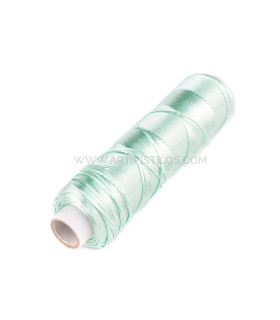
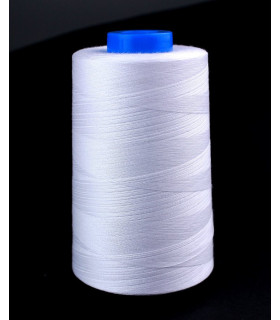
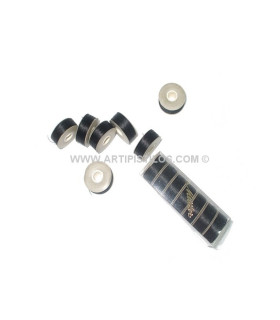
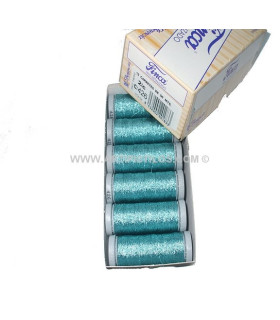
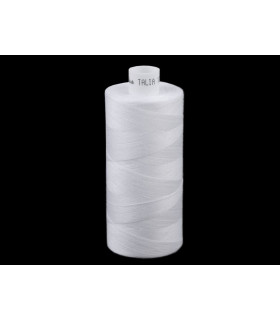
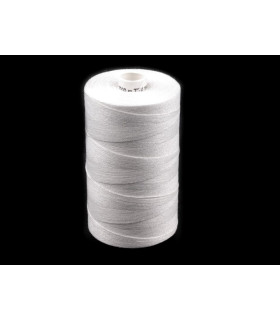
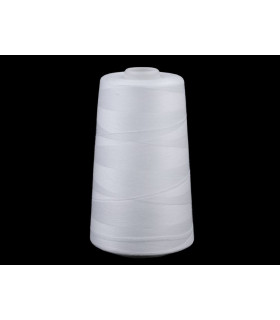
The sewing thread, along with the needle, is the most important material for sewing. Whether you are a professional in the field or an amateur, here you can stock up on the main types of threads in the market of the best quality.
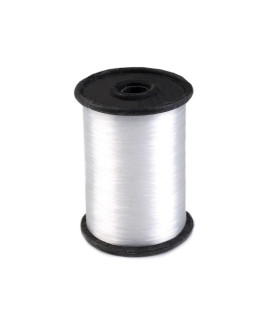
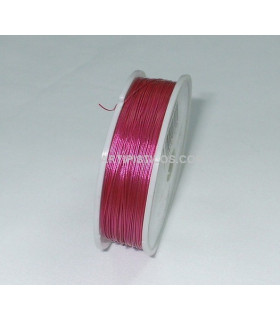
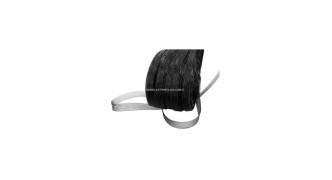
As for the material of our threads, you will find everything you might need for your work. Silk thread, polyester thread, nylon thread, viscose thread, rayon thread or cotton thread are some of them. We have some special spools of thread, like those of metallic thread or those of elastic thread.
Regarding colors, you will see that we have all the types you could wish for. Get any of them now in different thicknesses and in spools with up to 5 km of thread!
WHAT IS A SEWING THREAD?
A sewing thread is a long and very fine strand of a braided textile material. Its shape and manufacturing method are very similar to that of cords or ropes, albeit in a miniature version.
With the exception of silk and synthetic fibers, most textile fibers are very short, so it is necessary to spin them to create a continuous and longer thread. This operation, usually carried out in a spinning mill, involves twisting several short fibers together to join them, thus creating a longer strand. Approximately, each sewing thread is composed of about 30 tissue fibers.
It is known that Homo Sapiens began to create threads with plant fibers about 20,000 years ago. Until the Industrial Revolution of the 19th century, threads were spun manually, or preferably, by machines such as the spinning wheel or spindle.
WHAT IS FABRIC?
Textiles or fabrics are sheet-like materials that are made by crossing and binding threads or fibers.
When this process is done with longitudinal (warp) and transverse (weft) threads, they are called ‘woven textiles’. When it is done by looping that forms a mesh, they are called ‘knitted textiles’ or ‘knits’. Textiles can also be made by crossing two or more warp threads without weft, such as some types of tulles.
The textile industry is known as weaving. The manufacturing of fabrics from natural, artificial, or synthetic fibers, along with their multiple combinations, generates a wide variety of fabric types.
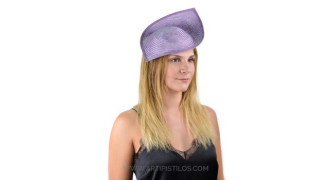
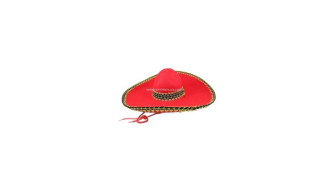
Humans created different types of textiles to protect their bodies and homes from various climatic phenomena (heat, cold, rain, wind, light). In the Neolithic age, flax was spun for summer and wool for winter, for which they invented the spindle and the loom. Later, all kinds of accessories, tools, and complements were created with fabric, among them hats.
The design of the looms were refined over the centuries, but by and large, did not undergo major changes until the inclusion of the steam engine. Thus the industrial loom was born, dramatically multiplying the production of textiles and consequently reducing their price.